America’s strategy: lower costs and remote management
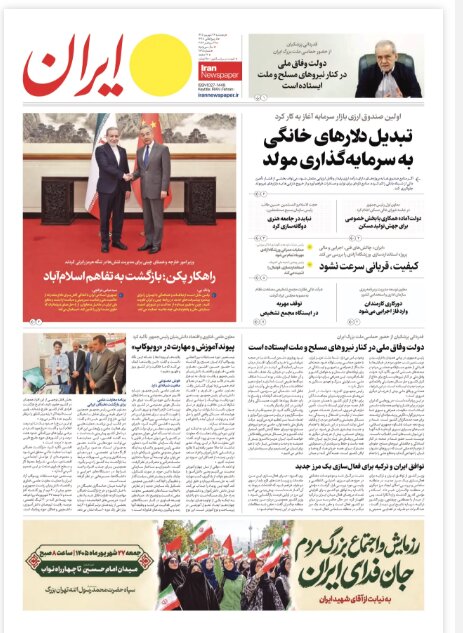
The Iran newspaper analyzed the United States’ current regional strategy. According to the paper, regardless of the outcome of the war with Iran, Washington appears intent on reducing its security commitments and costs in the region.
The formation of agreements such as the Mecca Pact can be interpreted within this framework. At the same time, the US is increasingly focused on containing China and the Asia-Pacific, preferring to manage regional developments remotely rather than through direct presence. Within this approach, the US seeks to turn the region into a space where rivals such as Iran, Russia, and China incur greater costs, rather than a theater for Washington’s own direct and expensive intervention. Rising energy costs for China and Europe are also seen as outcomes that could benefit the US. From this perspective, the naval blockade can be understood as a measure aimed at increasing pressure and gradually eroding Iran—pressure pursued without dragging the US into a large-scale, costly war.
Ettelaat: Tehran’s role in the emerging global economic order
Ettelaat examined President Pezeshkian’s participation in the 18th BRICS Summit in India. His presence—amid the US and Israeli-imposed war against Iran—offered a significant opportunity to strengthen Iran’s position within a multipolar order, expand economic diplomacy, and present a strong, active, constructive image of the country. The success of this engagement depends on internal coordination, managing expectations, focusing on practical projects, and reinforcing a positive, hopeful discourse. The event can be viewed as a “victory for development diplomacy.” Global gatherings such as BRICS, which bring together major and emerging powers from several continents, provide an ideal platform for expressing Iran’s stance regarding the imposed conflict. While appreciating BRICS’ statement condemning US and Israeli military aggression against Iran, the paper argues that Iran must make optimal use of this opportunity—especially in economic and financial domains.
Arman-e-Melli: A highly significant trip to Beijing
Arman-e-Melli highlighted the importance of Abbas Araghchi’s trip to Beijing amid regional tensions. According to the paper, what matters in analyzing current developments is this visit by Iran’s foreign minister. Given that Saudi Arabia canceled the planned Oman meeting, many analysts link Beijing’s selection as the destination to China’s potential mediation between Iran and Saudi Arabia. Whether these two matters are directly connected remains speculative, but China has adopted principled positions on regional developments in recent months. For this reason, some believe China may soon engage directly and effectively in regional dynamics.
Ham-Mihan: Failure in the Muscat meeting
Ham-Mihan, in an interview with foreign policy analyst Mohsen Jalilvand, explored the reasons behind the failure to hold the Muscat meeting. He argues it was clear from the outset that such a meeting would either not convene or, if held, would produce no tangible results—because the main actors, especially the United States and Israel, were absent from the negotiating table. Even if Tehran and Muscat reached a bilateral agreement on navigation protocols, the absence of defined and enforceable military deterrence boundaries or maritime transit arrangements means no deep strategic shift would occur. The international significance of the Strait of Hormuz stems from the fact that any change in its status is directly tied to the balance of power between Iran and the US, as well as broader Middle Eastern security dynamics. Although Persian Gulf states suffer the greatest economic vulnerability from shipping insecurity, they do not hold the final decision-making leverage. Therefore, technical agreements between Tehran and Muscat alone cannot resolve the current deadlock.
Leave a Comment